
Top Signs You Need Air Duct Cleaning Service – Don’t Ignore These
Dust on your supply registers is a low-urgency signal: it usually means the last few feet of duct near the vent are dirty, nothing more. Black particulate crusted around the register edges is a different problem entirely, and treating the two as the same thing is how people either panic over normal dust or ignore something that needs attention now. The signs below are ordered roughly by urgency, and for each one we explain what it actually tells you about what’s happening inside the system, so you can judge severity instead of just recognizing a symptom on a list.
This isn’t a job worth DIYing. Ducts are a closed system, and poking a shop vac into a register won’t reach the debris that’s settled on the trunk lines and in the plenum. If you read through these and something matches, call (877) 820-9183 for a free estimate from Parker Air Duct Cleaning Pros.
When Dust on a Register Becomes a Biofilm Problem
Surface dust is normal. Every system accumulates some. The urgency question is what kind of material you’re looking at, and the color and texture tell you most of it.
Ordinary dust is grey to brown, loose, and wipes off easily. It’s a maintenance item, not an emergency, and it often comes back because filtration is doing part of the job rather than all of it. Dust like that in a Parker home is worth monitoring, not panicking over.
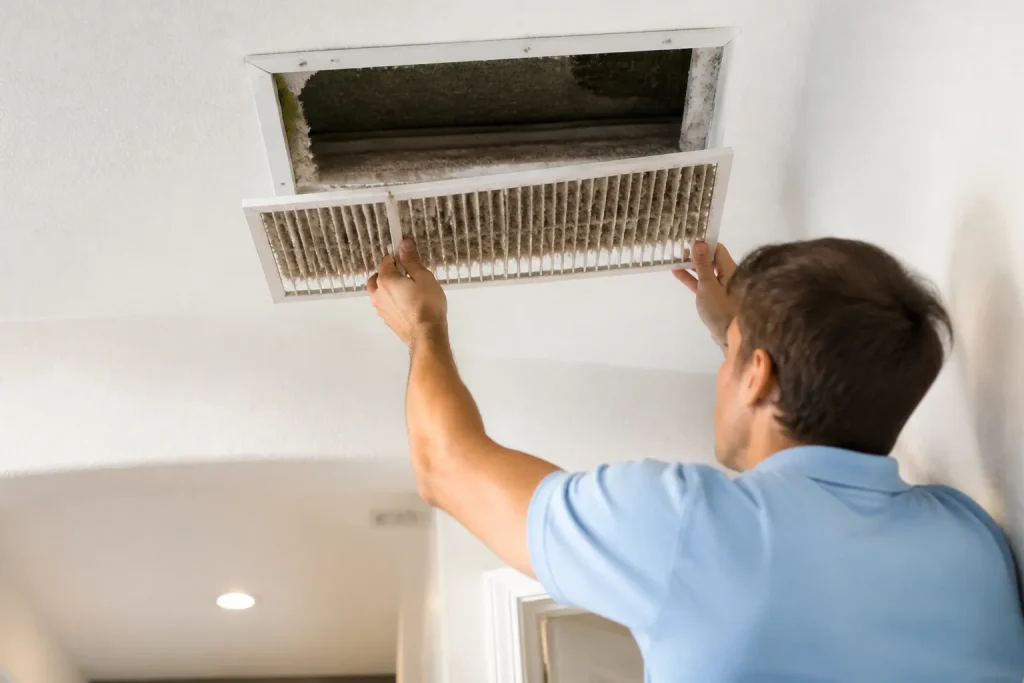
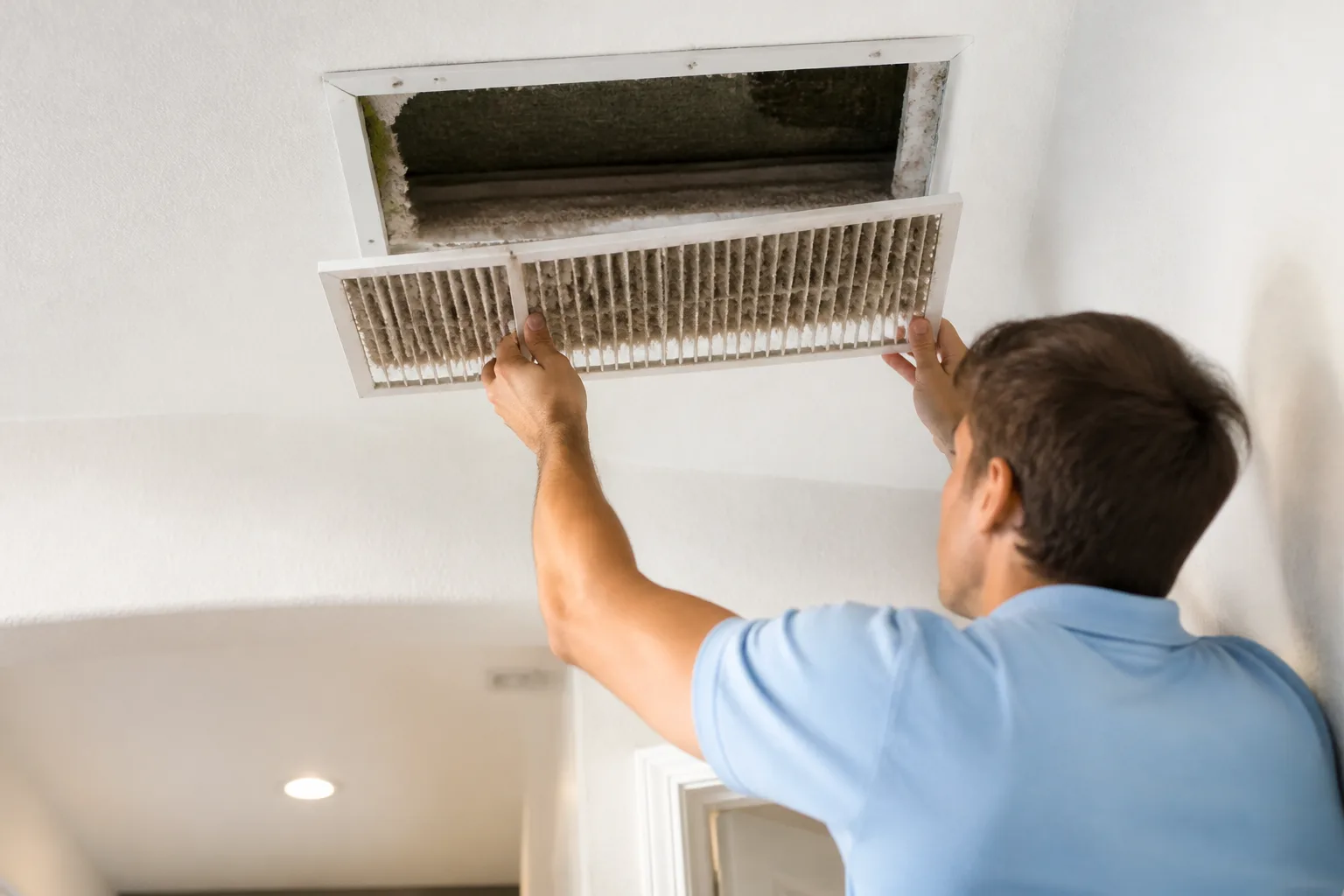
What changes the category is a dark, sticky or powdery-black coating, especially where it’s concentrated at register edges and on the fins of the vent cover. That pattern suggests moisture is present somewhere in the duct run, and damp organic material is what feeds microbial growth. Once growth establishes on the duct interior, dust alone doesn’t describe what’s going on anymore. You’re dealing with an air quality issue that cleaning and sanitizing addresses as two parts of one job, not a cosmetic one.
Here’s the short version of the difference:
- Loose grey dust on the register face: low urgency, consistent with ordinary accumulation.
- Dark staining around register edges and ceiling near the vent: check for moisture or condensation upstream before assuming it’s just dirt.
- Musty smell that intensifies when the system runs: higher urgency, points toward microbial growth in the duct interior or drain pan.
- Visible growth on the back of a register cover: needs professional evaluation, not a wipe-down.
If you’re seeing the lower end of that list, it’s worth having an experienced eye look at it. Our technicians have up to 8 years of experience reading exactly these patterns, and the difference between dust and microbial growth changes the scope of the work entirely.
Uneven Airflow Between Rooms: Why It’s Usually Blockage, Not Sizing
In most homes we look at, uneven airflow is treated as a design problem – the room “never got enough duct” – when the more common cause is restriction. A duct that’s sized correctly for a room can underperform badly if debris has narrowed the run, collapsed an insulated flex line, or blocked a branch fitting. The room didn’t get shorted on duct. The duct got strangled.
The tell is change. A room that was never as strong as the others may have always been that way. A room that used to keep up and stopped keeping up is a restriction story almost every time. Pay attention to which rooms fail to keep up and when:
- One room weak, all others fine: suspicion falls on that single branch run or its damper.
- Far end of the house weak: consistent with static pressure loss along the longest runs, often made worse by debris.
- Second floor weak while first floor is strong: pressure balance and return path, not always duct dirt, but it’s the first thing to rule out.
- Strength fine but the air smells off: the flow is moving fine, the problem is what it’s moving.
This is also where surface-level fixes fall apart. Bumping blower speed or opening dampers can mask a restriction. It doesn’t clean it out. A proper look inside the system, which our air duct cleaning work starts with, tells you whether the problem is debris, separation or a collapsed line.
Why Parker’s Elevation Makes Duct Restrictions Show Up Faster
Parker sits high, and thinner air changes how a system behaves. A blower moving the same volume of air at altitude does it with lower density, and the pressure the system develops against duct resistance, its static pressure, reads differently than the same setup would at lower elevation. In practice, restrictions that would creep up gradually on a system at sea level become noticeable sooner here. The system has less margin to give before you feel it.
What that means for you: a duct run that’s partially fouled can show up as weak airflow, a blower that runs louder or longer, or a room that feels borderline on the hottest afternoons. The equipment isn’t failing. The duct is working against it. Homeowners in Parker sometimes replace parts or chase a blower motor when the real issue is a restricted system that gained less tolerance than expected at this altitude.
This is one reason we lean on professional-grade equipment rather than improvised tools. A Nikro HEPA-rated vacuum captures fine particulate at the source instead of recirculating it, and a Rotobrush rotary-brush system mechanically agitates and extracts what’s clinging to the duct walls. At this elevation, with less performance margin to absorb a half-cleaned system, the difference between extraction and agitation matters. We also keep Abatement Technologies air-filtration units on the job for negative-pressure containment, the same protocol used in remediation work, so loosened particulate is pulled out rather than pushed into your living space.
If the airflow complaints in your Parker home feel out of proportion to the system’s age, a restriction is a good first suspect.
Reading Your Allergy Symptoms Like a Symptom Map
Allergy symptoms aren’t random. Their pattern is a diagnostic clue, and it can point to where in the duct system the problem likely originates. That’s more useful than a general “is this a dust problem” question.
Pay attention to timing and location:
- Worst in the morning, better after leaving the house: suggests what settles in a bedroom duct overnight is airborne during sleep – bedroom supply runs and the return that serves them.
- Worst after system startup: suggests loose debris getting kicked up when airflow begins turning over surfaces – trunk line accumulation is the usual source.
- Bad only in specific rooms: a local branch problem rather than a house-wide one.
- Year-round and worse indoors than out: the inside air is contributing, not just seasonal pollen.
- Everyone in the house, not just one person: reduces the likelihood that this is an individual sensitivity and increases the odds that the air itself is carrying something.
None of this diagnoses an allergy – that’s a doctor’s call. But a spatial pattern gives a technician a starting point for where to look. When the pattern points to the ducting, a full HVAC cleaning looks at more than the ducts. Our HVAC cleaning also covers the components the ducts connect to, including the air handling equipment and coil surfaces, because a spotless duct run feeding a fouled coil doesn’t fix the air. If you have a Honeywell or Aprilaire filtration or humidity system already installed, we work with those too – knowing how they perform helps us judge whether your filtration is actually catching what your ducting is releasing.
The Post-Renovation Dust Most Homeowners Miss
You finished a remodel, swept up, ran the system, and figured you’re done. The problem: drywall dust, sawdust and sanding residue don’t stay in the room. Fine construction particulate bypasses a standard filter, drifts into the returns while the system runs, and settles inside the ducts. The rooms look clean. The system isn’t. This is the indicator most people never check for, and it’s one of the highest-value reasons to schedule cleaning.
It’s worth a look any time there’s been meaningful drywall work, sanding, cabinet replacement or flooring removal anywhere in the home, and it’s worth checking sooner rather than later because fine particulate in a duct is more than a nuisance – it can coat components and be re-released every time the system cycles. Drywall dust is abrasive in ways normal household dust isn’t.
There’s a related safety issue repair and remodeling with a common workaround: dryers. Remodeling creates lint and dust, some of it in the drying path or the vent line. On that note, dryer vent cleaning is a fire risk, not a comfort issue, and it deserves the same priority as the system above it. Lint is fuel, and a clogged vent is the most common cause of a dryer fire. If you’ve had a renovation, it’s worth checking.
When to Call a Pro
Some signs are worth watching. Others are worth acting on today. If you’re seeing any of the following, it’s time to call:
- Musty smell that gets stronger when the system runs.
- Dark staining or visible growth on registers or in the duct interior.
- A room that used to keep up and no longer does.
- Recent renovation with drywall dust or sanding work anywhere in the home.
- A dryer that takes longer than it used to dry a typical load.
Calls outside our dispatch hours get booked into the next opening, Sunday through Friday, 7am to 7pm. We answer 24/7.
Related services in Parker: airflow issues usually start with air duct cleaning, and if a renovation left you wondering about the dryer path, dryer vent cleaning covers that too. The HVAC cleaning service handles the components above the ducts, and we can bring Parker Air Duct Cleaning Pros into it as your single point of contact for the whole chain.
The Bottom Line
Dust on the register is a low-urgency signal. Black staining at the edges, a musty smell that strengthens with airflow, or a room that has stopped keeping up are more urgent – and at Parker’s elevation, restrictions show up as performance problems faster than you’d expect. Post-renovation dust is the one most people miss, and it’s among the easiest to confirm with a proper look inside the system.
If you’re in Parker and need help, Parker Air Duct Cleaning Pros offers free estimates – call (877) 820-9183. The estimate is free, the written estimate sets the final price, and you’ll see before-and-after documentation of your own ducts when the work is done. If a technician has to come out, that’s fine: the written estimate is agreed before work starts.
Written by the team at Parker Air Duct Cleaning Pros.
Frequently Asked Questions
Normal dust is loose, grey-brown, and light on the register face. It’s a maintenance signal, not an emergency. You likely need professional cleaning when dust is dark or sticky, when there’s staining around register edges, when a musty smell strengthens with airflow, or when a room that used to keep up has stopped. Call (877) 820-9183 for a free estimate.
Because duct restriction, not system sizing, is usually the cause. Debris buildup, a collapsed flex line or a blocked branch narrows the run and starves that room of airflow. At Parker’s elevation, with less static pressure margin, a restriction shows up as a performance problem sooner. That’s worth a look from a specialist who can inspect the run rather than guess from the thermostat. Our technicians have up to 8 years of experience with exactly this kind of diagnosis. Estimates are free – call (877) 820-9183.
There’s no universal schedule – it depends on your home. Most homes benefit from inspection periodically and cleaning when a real indicator is present, not on a fixed calendar. Homes with pets, recent renovation, allergy sufferers or a history of moisture issues may need a look more often. The honest answer for your home comes from inspecting the system, not a generic rule. Call (877) 820-9183 and we’ll tell you what we find.
You see the evidence. Rotobrush rotary-brush extraction produces visible, documented before-and-after results, and we show those of your own ducts – not stock photos. Combined with Nikro HEPA-rated capture at the source and Abatement Technologies containment during the job, you can verify what came out of the system, not just take our word that it did. Call (877) 820-9183 for a free estimate.
We answer 24/7. Fast dispatch from 7am to 7pm, Sunday through Friday.
Need Air Duct Cleaning Help?
Call Parker Air Duct Cleaning Pros - the local pro we connect you with is licensed and insured, here with fast help in Parker.
(877) 820-9183