
How to Choose the Right Air Duct Cleaning Company in Parker
The fastest way to choose a duct cleaning company in Parker is to ask what equipment it uses before you ask what it charges. The trade has almost no barrier to entry. A van, a shop vac, and a Google Business profile are enough to start taking jobs, which means the usual advice to check reviews and get three quotes won’t filter out the operators most likely to leave your ducts exactly as they found them. In this guide we’ll give you specific, testable questions that separate a specialist from a generalist with a vacuum.
Key Takeaways
- Ask for the vacuum’s CFM rating and the tool type before you book a single job.
- NADCA membership costs a few hundred dollars a year and requires no equipment inspection. Treat it as a starting point, not a finish line.
- A dedicated air duct specialist does one trade all day. A generalist HVAC company adds duct cleaning as a seasonal extra.
- No pre-job walkthrough means the quote is a guess.
- Before-and-after photos are the only real proof the work happened.
What Equipment Questions Should You Ask Before You Book?
A contractor who cleans ducts for a living can answer equipment questions in plain language without checking with anyone. If the person on the phone can’t tell you the suction power of the machine coming to your house, that’s your first signal. Here are the questions that sort the field quickly:
- What’s the CFM rating of your vacuum? CFM measures how much air the machine moves. Consumer vacuums and shop vacs sit at the bottom of the range and can’t sustain suction through a long duct run. Professional duct-cleaning systems are built for the job, and the contractor should know the number off the top of their head.
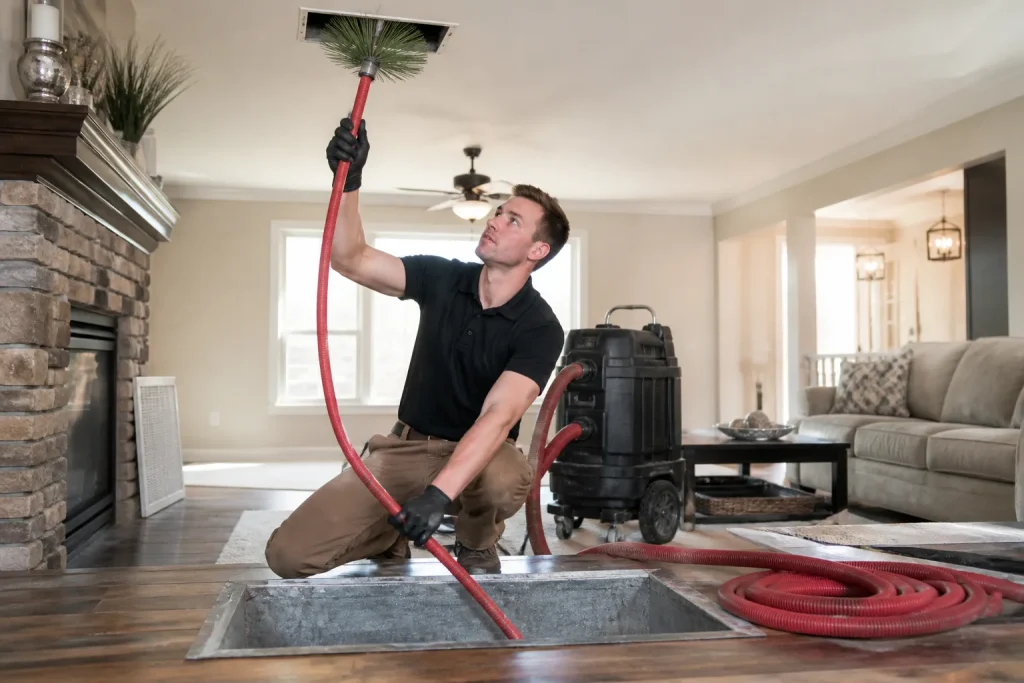
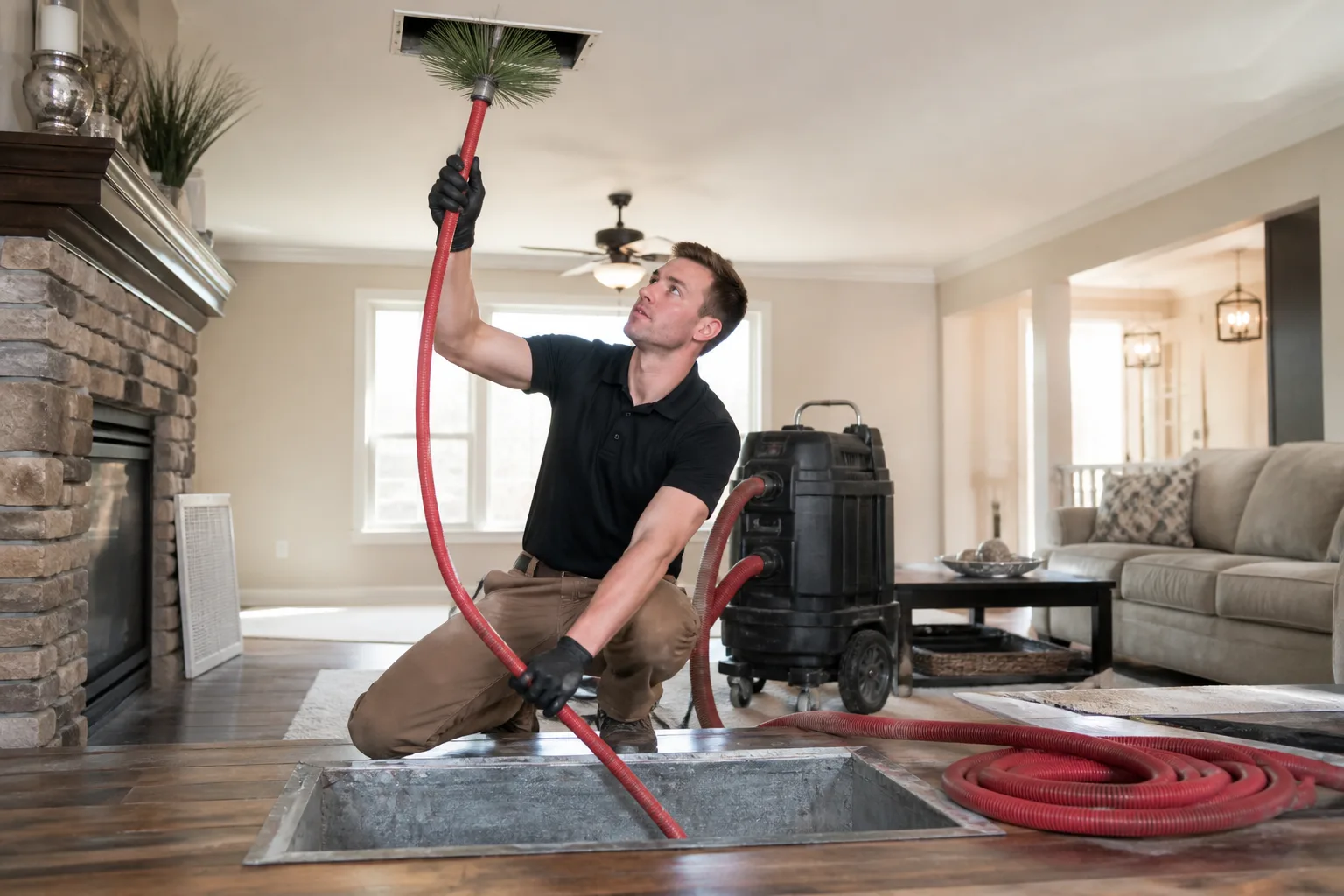
- Do you use contact or non-contact cleaning tools? Contact tools physically touch the duct walls. Non-contact tools rely on air pressure alone. A good setup uses both, matched to the duct material. Only one or the other usually means part of the system stays dirty.
- How do you handle flex duct? Flex duct is the corrugated, bendable material common in attic and crawlspace runs. It’s fragile and tears if you treat it like rigid metal. Ask how the technician adjusts pressure and tool type for it. A vague answer here is worth paying attention to.
- Do you use HEPA-rated filtration? A vacuum that captures fine particulate at the source keeps it out of your living space. One that just blows air through a basic filter recirculates what you were trying to remove.
- What containment do you set up? Purpose-built air-filtration equipment, like the Abatement Technologies units used in remediation work, creates negative pressure so dust stays in the work area instead of drifting into the next room.
None of these questions require you to be an engineer. You’re listening for fluency. The specialist team at Parker Air Duct Cleaning Pros answers them for Parker homeowners every day, and the difference between a rote answer and a real one is obvious.
Why Does a Specialist Beat a Generalist HVAC Company?
A generalist HVAC company does heating and cooling repair, installs systems, and may add duct cleaning as a seasonal line item when things slow down. A dedicated indoor-air specialist does one trade, every day, on purpose. That structural difference shows up in job quality in ways that are hard to fake.
Think about what happens inside a generalist shop. Duct cleaning equipment is expensive. It sits in a corner most of the year and gets pulled out when a customer asks. The technician running it might be a furnace repair tech who got a half-day of training on it. The job gets done. Whether it gets done well depends on who shows up that day.
Now consider a shop that does nothing else. The equipment is the workhorse, not the afterthought. Rotary-brush extraction systems are used constantly, so the technician knows how the brush behaves in different duct sizes and materials. That kind of familiarity compounds. Nobody becomes an excellent duct cleaner as a sideline.
How to Tell Them Apart
- Ask what percentage of their work is duct cleaning. A specialist will give you a straight answer.
- Ask whether they clean the full system, including the air handler and blower, or just the visible runs.
- Ask if they handle duct repair and sealing when they find gaps or disconnected joints. A specialist can fix what they find. A generalist often has to hand you off.
- Look at how they describe the process on a call. Detail is a good sign. Vague reassurance isn’t.
Full-chain capability matters more than most people expect. If the technician finds a crushed flex run or a joint that’s pulling apart, the right answer is to repair and seal it during the same visit. Coordinating a second contractor for a connected problem is a hassle nobody needs.
What Should a Pre-Job Walkthrough Include?
A company that quotes your job over the phone without seeing your system is quoting blind. Ductwork varies enormously from house to house in Parker, and a price built on a guess is going to move once someone is standing in your basement. A proper walkthrough is short, maybe fifteen minutes, and it covers specific ground.
- Counting and inspecting every supply and return. Not estimating from square footage. Walking the house.
- Looking at the air handler and blower. That’s where a lot of the buildup lives, and it’s frequently skipped when crews rush.
- Checking duct material and condition. Rigid metal, flex, and duct board each need different tools and pressures.
- Looking for gaps, disconnects, and pest evidence. A disconnected joint in an attic run can pull attic air into the living space.
- Noting any filtration or humidity equipment already in place. If you have a Honeywell or Aprilaire system, the technician should recognize it and know how it interacts with the cleaning.
The walkthrough is also your chance to ask what happens to the fine dust. Ask specifically about HEPA-rated vacuum systems and negative-pressure containment. If the answer sounds like a sales pitch and not a process description, you have your answer about the company.
What Are the Red Flags Specific to the Parker Market?
Parker has grown quickly, and the duct cleaning market here reflects it. Plenty of good operators work this area. Plenty of others run on volume and cheap advertising. Watch for these patterns, because they’re the ones we hear about most.
Bait-and-switch per-vent pricing. Quoted at one number per vent, then the invoice arrives with more vents counted than you agreed to, or a surcharge for “heavy buildup” added on site. A price per vent invites this. A flat price per system, agreed before work starts, doesn’t leave room for it.
Air purifier upsells bundled into the quote. Cleaning and equipment sales are different conversations. If an air purifier appears in your duct cleaning quote without you asking, separate them. Filtration and humidity equipment has a real place, but a cleaning contractor who also happens to sell you a $2,000 box on the same visit is worth a second look.
Refusal to provide before-and-after photos. Mechanical work leaves visible evidence. A contractor who won’t photograph your own ducts before and after is asking you to take their word for it. You shouldn’t have to.
No walkthrough, no written estimate. A verbal number on a phone call isn’t a quote. It’s a starting point for a negotiation you’ll lose.
Pressure to book immediately. Duct cleaning is scheduled work. Nobody who does it well needs to close you on the first call.
How Do You Read Reviews for Duct Cleaning Specifically?
Review language matters more than star count. Duct cleaning is a service where the customer often can’t see the results, so reviews tend to describe the experience rather than the outcome. That’s exactly what makes them useful, if you know what to look for.
Positive reviews that signal real work tend to mention specifics. The technician showed them photos of the inside of their ducts before cleaning. They saw what came out of the system. The crew found and fixed a disconnected joint. The house smelled different afterward. Someone can describe a specific finding because it happened.
Reviews that signal a smooth sales experience are vaguer. Friendly, on time, professional, easy to schedule. Those things are fine, but any competent operator delivers them. If an entire review profile sounds like that and nothing else, the company may be better at customer service than at cleaning ducts.
Read the negative reviews carefully too. A one-star complaint about a scheduling mix-up is ordinary. A pattern of complaints about the invoice being higher than the quote, or about no visible difference afterward, tells you something structural. Sort by lowest rating first and skim. It takes two minutes.
One more thing. NADCA membership costs a few hundred dollars a year and requires no equipment inspection. It’s a signal that a company takes the trade seriously, and it’s a reasonable starting point. It tells you nothing about whether the truck that shows up has a real duct-cleaning machine in it. Ask about the equipment regardless.
When Should You Call a Pro Instead of Waiting?
Duct cleaning isn’t a routine chore. Most homes don’t need it on a fixed schedule. The triggers to watch for are specific: recent renovation dust, evidence of pests in the system, visible mold concerns, a new home with unknown system history, or allergy symptoms that seem worse indoors than out. If you’re a parent of young children or a property manager responsible for a building, those triggers matter more.
The one service where waiting is a genuine safety issue is your dryer vent. A clogged dryer vent is a fire risk, not a comfort concern. Lint builds up, restricts airflow, and can ignite. If your clothes take two cycles to dry or the vent flap outside barely moves, get it handled. The same holds for electrical and gas equipment in your HVAC system: if something smells wrong or trips a breaker, call a trained professional rather than opening a panel yourself.
If you’ve already found a company, one more useful step is a full-system clean that includes the air handler, not just the visible duct runs. And if you’d rather not spend your afternoon interrogating contractors, call (877) 820-9183. Estimates are free.
Related services in Parker: our air duct cleaning page covers what a full-system job involves, and our dryer vent cleaning page explains the fire-risk side. If your system needs more than cleaning, our HVAC cleaning work covers the air handler and blower.
The Bottom Line
Choosing a duct cleaning company in Parker comes down to a handful of testable questions. Ask about CFM, tool type, HEPA filtration, negative-pressure containment, and how they treat flex duct. Expect a walkthrough before any quote. Expect before-and-after photos of your own ducts, not stock images. Be skeptical of per-vent pricing, bundled equipment sales, and quotes given over the phone without a visit. Reviews help, but read them for specific findings, not just for friendliness.
The equipment brands matter too, because they tell you what kind of business you’re dealing with. Purpose-built systems from Rotobrush with HEPA-rated Nikro vacuum equipment are the tools of the trade. Familiarity with Honeywell and Aprilaire filtration equipment means the technician can speak to what’s already installed in your home. And Guardsman-grade sanitizing treatments have a legitimate place in air quality work when the situation calls for it. Our technicians have up to 8 years of experience, and they work one trade only.
If you’re ready to have someone walk through your home and give you a straight answer, that’s what we do. We answer 24/7. Fast dispatch from 7am to 7pm, Sunday through Friday. Call (877) 820-9183 for a free estimate, and you’ll get a flat price per system agreed before any work starts.
Frequently Asked Questions
Most whole-system jobs in Parker fall within a range set by system size and duct condition, and the written estimate sets the final number. We price per system, not per vent, because a per-vent price invites a higher invoice once the truck is in your driveway. Call (877) 820-9183 for an exact quote. Estimates are free.
No. NADCA membership costs a few hundred dollars a year and requires no equipment inspection, so it’s a useful starting point but not proof of anything. The real questions are about the vacuum’s CFM rating, the tool types used, and whether the contractor photographs your ducts before and after. Ask those regardless of membership status.
Most homes don’t need it on a fixed schedule. The triggers are specific: recent renovation, pest evidence, mold concerns, a new home with unknown history, or allergy symptoms that get worse indoors. A dryer vent is different. That one is a fire risk and should be checked when drying times lengthen. Call (877) 820-9183 if you’re not sure which situation you’re in.
Ask for before-and-after photos of your own ducts, taken during the visit. Mechanical extraction leaves visible evidence, and a contractor using real duct-cleaning equipment should have no trouble documenting it. If a company can’t or won’t provide photos, that tells you what you need to know. Call (877) 820-9183 and we’ll walk you through what our process documents.
Written by the team at Parker Air Duct Cleaning Pros.
Need Air Duct Cleaning Help?
Call Parker Air Duct Cleaning Pros - the local pro we connect you with is licensed and insured, here with fast help in Parker.
(877) 820-9183