
Air Duct Cleaning: Repair or Replace? How Parker Homeowners Decide
Clean the ducts first, then decide about repairs. That’s the advice almost every Parker homeowner hears, and it’s backwards. If the ductwork has significant leakage, cleaning it is roughly equivalent to mopping a floor with a hole in the bucket. You’ll pull the dust out, seal up the system, and then push a good share of your conditioned air into the crawlspace instead of the living room. The leaks have to come first, or at least be found first, so you know what you’re actually working with. Cleaning, repair and replacement are three separate decisions. Here’s how to tell which one your Parker home needs.
Does your ductwork need cleaning, repair or replacement?
Most Parker homes need cleaning and targeted repair, not a full replacement. Replacement is the right call for a minority of systems: crushed or collapsed runs, duct board with failing interior liner, or flex duct that has torn open at multiple joints. Cleaning alone makes sense when the ductwork is intact and the problem is accumulation. Repair makes sense when the ducts are dirty and leaking. A proper assessment during the cleaning job tells you which category you’re in.
What a technician should be looking at, in plain terms:
- Visible separation at joints and seams. Flex duct sections that have pulled apart at the collar, or taped joints where the tape has dried and let go, are the most common leak source in Parker homes.
- Crushed or kinked runs. Flex duct can collapse under its own weight, especially when it’s draped over a joist or compressed into a tight chase. A crushed run delivers almost no air regardless of how clean it is.
- Interior liner damage. Duct board and some flex products have an interior liner that can peel or degrade. Once the liner starts shedding, cleaning won’t fix it; the section has to come out.
- Moisture or microbial growth. Wet insulation or staining inside a duct points to a source that needs solving before any cleaning means anything.
- Pest intrusion evidence. Chewed flex, droppings, or nesting material usually means a breach that also leaks air.
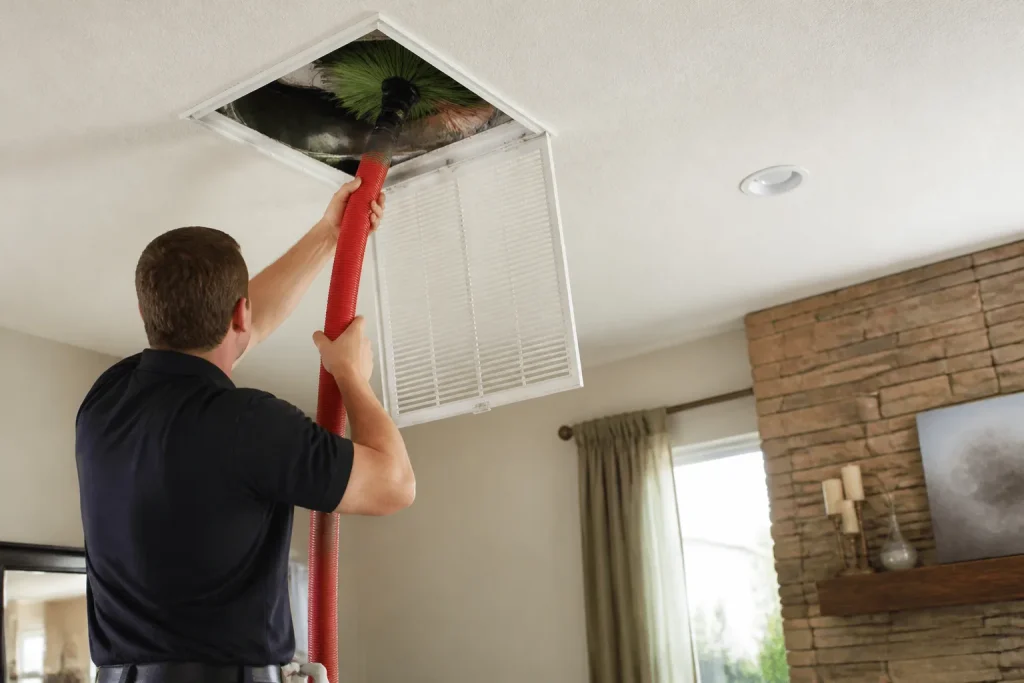
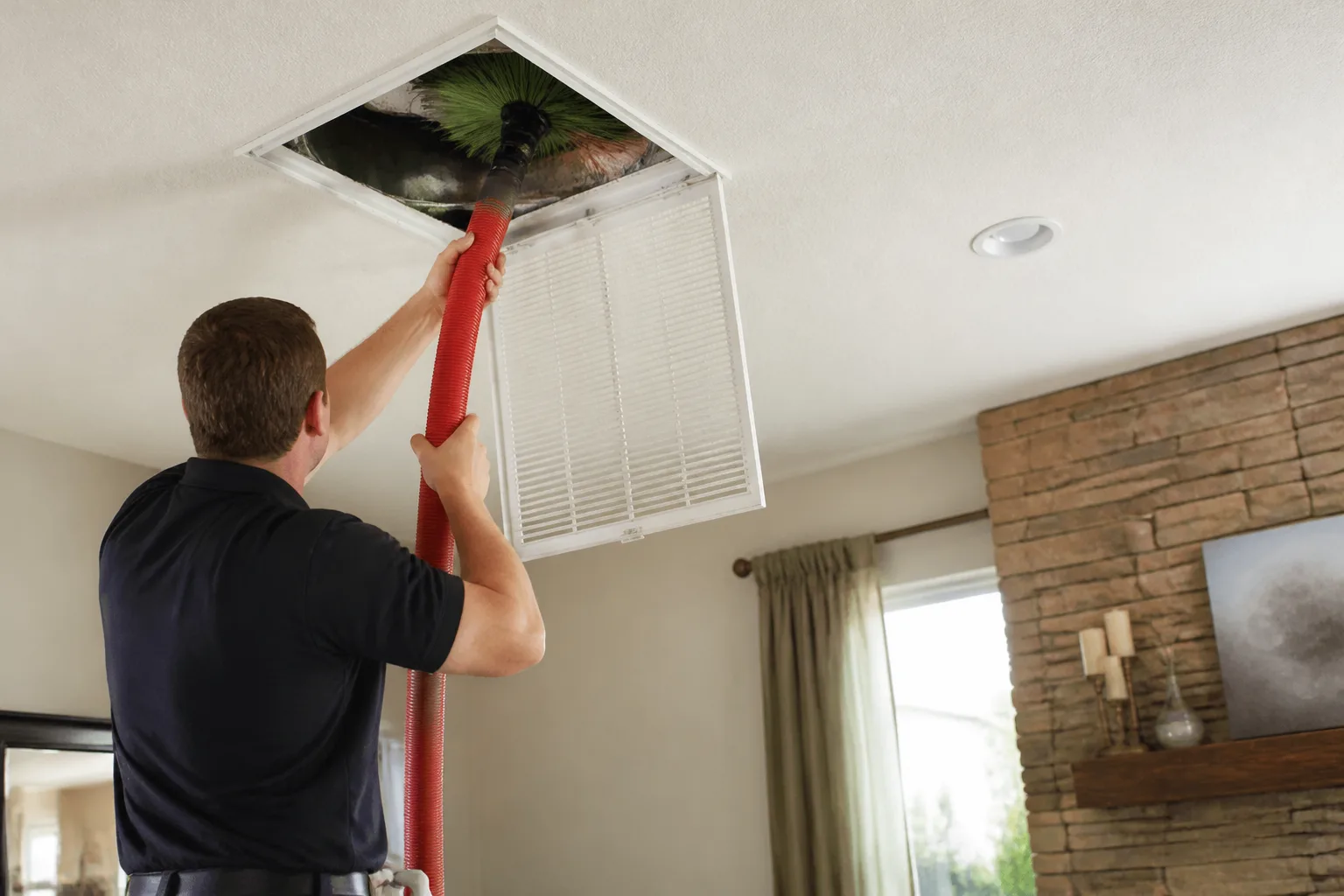
We assess condition before the cleaning equipment goes in, not after. Rotobrush rotary-brush systems and Nikro HEPA vacuums work well on sound ductwork, but they’re not a repair tool. Knowing what’s damaged up front keeps cleaning from becoming money spent on a system that can’t hold air anyway.
Why Parker ductwork ages the way it does
The 1990s and 2000s growth period in Parker left a lot of homes with flex duct, and flex duct degrades on a fairly predictable timeline. The outer jacket gets brittle and tears. The inner liner can separate from the wire helix. Tape and mastic at the connections dry out and crack. By the time a system is fifteen to twenty-five years old, the joints are usually where the problems show up first.
Parker’s climate adds pressure. Heating season and cooling season both run hard here, so the system cycles heavily in summer and winter, and each cycle stresses joints and seams. Dry air through the heating months, condensation inside ductwork during the cooling months, and the occasional storm-driven humidity swing all work on the tape and mastic from opposite directions. None of that is unusual. It’s just the wear pattern we see in Parker homes that were built during the boom years.
Garage conversions, additions, and finished basements complicate things further. Those spaces often got ducted with runs that were sized for the original layout and never rebalanced, so some ducts work harder than they should. If a room in your Parker house has never heated or cooled properly, a leaking or undersized duct run is a common explanation.
When is sealing or repairing a duct enough, and when does it need replacing?
Sealing and repairing solve the majority of duct problems. Replacement is reserved for sections where the duct material itself has failed.
Repair is usually the right call when:
- Leaks are at joints, seams, collars and connections
- Flex duct has a small tear that can be properly wrapped and sealed
- The run is structurally sound and delivers air to the room
- The problem is one or two sections, not the whole system
Replacement of a section is usually the right call when:
- The duct is crushed, collapsed, or compressed enough to strangle airflow
- Interior liner is peeling or degrading
- Flex duct has failed over a long run, not just at one joint
- The duct is wet, moldy, or contaminated beyond what cleaning can resolve
- The run was never sized correctly for the room it serves
Mastic and mesh tape, applied properly, outperform standard foil tape over time in attic and crawlspace conditions. Foil tape alone tends to dry out and release. That’s not a small distinction in a Parker attic that swings from summer heat to winter cold. A repair that uses the right materials and is documented with photos is a durable fix. A repair that’s just re-taping a joint will fail again in a season or two.
How duct leakage affects your energy bills in Parker
Leaky ducts are expensive in a climate with two heavy seasons. The reason is simple: the air you paid to heat or cool doesn’t reach the living space. In a Parker home with meaningful leakage, a system can be losing a substantial share of its conditioned air into the attic or crawlspace before it ever hits a register. You run the furnace or AC longer to compensate, and the bill reflects it every month of the year.
The rough math looks like this:
- A system delivering less air than it should runs longer to reach the thermostat setting
- Every month, in heating season and cooling season, that extra runtime shows up on the bill
- Sealing and repair are one-time costs; the runtime penalty repeats until it’s addressed
In our experience, this is why the “clean first, repair later” approach frustrates homeowners. Cleaning a leaking system improves air quality, but it doesn’t recover the energy wasted through the leaks. Sealing the joints does, and it usually costs a fraction of what a full duct replacement would. When the fixes are targeted, the payback tends to arrive within a few seasons rather than a decade.
If you’d rather not sort all of this out yourself, call (877) 820-9183. We’ll walk through what your system is doing and what the realistic options are.
Why cleaning should happen after repairs, not before
Every repair you make to a duct system disturbs dust. Cutting, removing tape, fitting a new section, and sealing a joint all kick up material that then moves through the system. Cleaning after the repairs captures all of it in one pass. Cleaning first means some of that material settles in ducts that already got cleaned, and you’ll be back to square one.
The order that makes sense:
- Assess the system and identify leaks, damage and contamination
- Repair and seal the duct runs that need it
- Clean the full system, including the air handler and coils
- Sanitize if microbial growth or pest intrusion was found
- Document the work with before-and-after photos of the same runs
When you talk to a contractor, structure the conversation around this sequence. Ask each scope to be priced separately. Cleaning, repairs, and any filtration or humidity work should each appear as its own line with its own explanation. The written estimate sets the final price, and you should be able to see what you’re paying for and why. If someone quotes a single blended figure and can’t break it apart, that’s a conversation worth having before signing.
We handle the cleaning side with Rotobrush and Nikro equipment and use Abatement Technologies air-filtration units for negative-pressure containment during the job. If your repair scope ends up needing filtration or humidity equipment looked at afterward, familiarity with Honeywell and Aprilaire products helps us speak to what’s already in your home. Our full-chain approach covers air duct cleaning, dryer vent cleaning, HVAC cleaning, duct repair and sealing, and air quality and sanitizing. Getting the sequence right is the whole point.
When to call a pro before you spend anything
Call a pro when you’re not sure which decision you’re making. That’s the practical threshold. If you’re already confident the ductwork is sound and the only problem is accumulation, you know what you need. If you’re unsure whether the ducts are leaking, collapsed, wet, or contaminated, an assessment before cleaning saves you from paying for work that doesn’t fix the real issue.
Our technicians have up to 8 years of experience, and they’ve seen enough Parker systems to spot the difference between a dirty duct and a failing one. Before-and-after photos of your own runs give you proof the work was actually done, and the leaks were actually closed. Dryer vents are a separate safety matter worth its own assessment; a clogged dryer vent is a fire risk, not a comfort issue. If you need any of this handled, the professional you’re connected with is licensed and insured as their state requires.
The Bottom Line
Cleaning, repair and replacement are three separate decisions, and in most Parker homes they happen in this order: assess, repair what’s failing, then clean the system afterward. Replacement is reserved for crushed runs, failing liner and wet or badly contaminated ductwork. If you’re in Parker and need help, Parker Air Duct Cleaning Pros offers free estimates. Call (877) 820-9183. We answer 24/7. Fast dispatch from 7am to 7pm, Sunday through Friday.
Frequently Asked Questions
You need an assessment before any of those decisions. Visible separation at joints, crushed runs, failing liner, moisture, or pest evidence points toward repair or replacement. A system that’s structurally sound and simply dirty points toward cleaning. Your estimate breaks the scopes apart so you can see which is which.
Cleaning a leaking system improves air quality, but it doesn’t fix the air loss. The leaks have to be addressed first, then the system cleaned, or you’re pushing clean air into your attic instead of your living room. If you’re not sure about leakage, call (877) 820-9183 for an exact quote. Estimates are free.
There’s no fixed interval. Homes with pets, recent renovation dust, allergy concerns, pests, or moisture issues justify more frequent cleaning. Homes with intact ductwork and clean filtration may need it much less often. Condition and history matter more than a calendar deadline.
Cheap quotes often skip the assessment, so you end up paying twice when the real problem wasn’t addressed. Ask what equipment is being used, whether the assessment and repair scopes are separate, and whether before-and-after photos of your own duct runs will be provided. Call (877) 820-9183 for an exact quote. Estimates are free.
Related services in Parker
If your assessment points in a specific direction, the dryer vent cleaning and HVAC cleaning pages cover those scopes in more detail. Both are worth looking at before the technician arrives, so the conversation starts from the same page.
Call (877) 820-9183 for a free estimate. We answer 24/7. Fast dispatch from 7am to 7pm, Sunday through Friday, and we’re closed on Saturday.
Written by the team at Parker Air Duct Cleaning Pros.
What happens when you call
- 1
A real person answersNo phone trees – you reach a local pro.
- 2
You get an upfront price rangeHonest numbers before anyone is dispatched.
- 3
A background-checked tech heads outLicensed & insured, dispatched right away.
- 4
You approve before work beginsNothing starts until you say go.
Need Air Duct Cleaning Help?
Call Parker Air Duct Cleaning Pros - the local pro we connect you with is licensed and insured, here with fast help in Parker.
(877) 820-9183