
Air Duct Cleaning Pricing Breakdown: What Parker Homeowners Pay in 2026
A $199 quote and a $650 quote for the same Parker home usually aren’t two prices for one job. They’re two different jobs wearing the same label. One quote may include supply and return lines, the main trunk, and the plenum box. The other may run a vacuum hose over the visible floor registers and call it done. In 2026, most Parker homeowners in a typical 2,000 to 3,000 square foot house should expect something in the range of $350 to $700 for a genuine whole-system cleaning, with outliers on either end telling you more about scope than about savings. If you’d rather have someone walk the system and quote it properly than guess from a phone number, call (877) 820-9183.
Why do duct cleaning quotes in Parker vary by hundreds of dollars?
Because “duct cleaning” isn’t a standardized unit of work. There’s no industry-wide definition that says a quote must include the trunk line, the return plenum, the blower compartment, and every branch run. Companies build quotes from whatever they choose to include, and the price follows the scope. A low number is often a low scope, not a low margin.
In our experience, the gap comes down to four things:
- What’s actually cleaned. Supply registers only, or supply plus returns plus trunk plus plenum plus blower compartment?
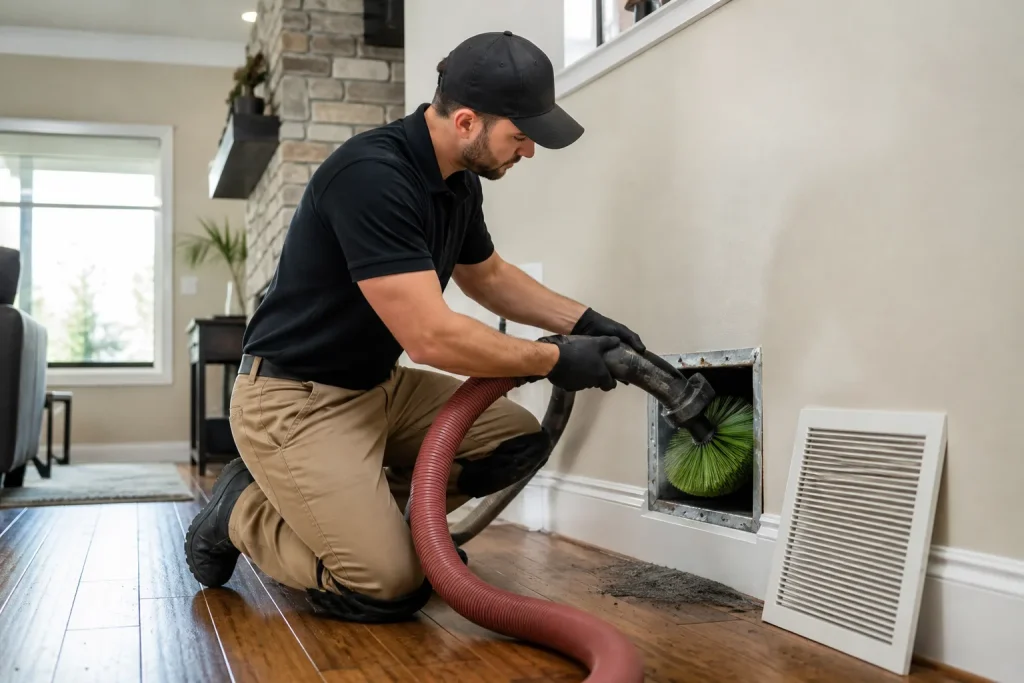
- Method. A rotary brush and HEPA vacuum setup takes longer and captures more than a shop vacuum and a hose.
- Access. A basement or garage mechanical room is easy. A sealed attic air handler in August is not.
- Condition. Heavy drywall dust after a renovation, pest debris, or a system that hasn’t been touched since the house was built all add time.
None of those are tricks. They’re the honest variables. The problem is that two quotes can look identical on paper while covering completely different work. That’s the comparison to fix before you compare price.
What actually drives the price in a Parker home?
Four physical things move the number more than anything else: home age, duct material, the number of returns, and how easy the mechanical components are to reach. Parker’s housing stock spans decades, and the ductwork inside it reflects that span.
Home age and build era
Newer builds often use flex duct, which is faster to clean but has more turns to negotiate. Older homes are more likely to have rigid sheet metal trunk lines with branch runs that have collected decades of dust, and sometimes disconnected joints that a cleaning will expose. That’s not a bad thing to find. It’s information you didn’t have before.
Flex duct versus sheet metal
Flex duct is corrugated, so debris settles in the ridges and the cleaning method has to work with the material rather than tear it. Sheet metal is smoother but often larger in diameter and longer in run. Whichever you have, the technician should confirm the material before quoting so the method matches the duct.
Number of return lines
Returns are the half of the system most low quotes skip. A home with one central return is a shorter job than a home with returns in every bedroom. Returns carry the same air the supplies deliver, so leaving them out means half the system stays dirty.
Access in ranch and split-level layouts
Parker has a lot of ranch and split-level homes where the air handler sits in the garage, a closet, or an attic. Garage and closet placements are straightforward. Attic units in a low-pitch roof space take longer, and that time shows up in the quote. It should, because it’s real.
Per-vent pricing versus whole-system pricing: which one actually helps you?
Whole-system pricing is the one that protects you. Per-vent pricing sounds transparent because you can count your registers and multiply, but it quietly incentivizes a company to clean the easy vents and skip the trunk, the plenum, and the blower compartment, which are where the heaviest contamination collects.
Here’s the practical difference:
- Per-vent quoting gives you a number tied to visible registers. It says nothing about the main trunk line, the return plenum, or the blower. A home with twelve vents can be quoted at a low per-vent rate and still get a partial cleaning.
- Whole-system quoting prices the entire air path: every supply run, every return, the trunk, the plenum boxes, and the blower compartment. One flat price, agreed before anyone starts.
For a homeowner, the second model is far easier to compare across companies. Ask each one directly: does this price include the trunk line, both plenums, and the blower compartment? If the answer is vague, the quote is vague.
Which line items should always be included, and which get quietly dropped?
Three items get dropped from low quotes more than any others, and all three matter. Ask about them by name before you book.
- Main trunk lines. The largest duct in the system and the one carrying the most air. If it’s excluded, the job is partial.
- Plenum boxes. The transition between the air handler and the ductwork. Dust and debris collect heavily here because airflow changes direction.
- Blower compartment. The fan that moves every cubic foot of air in your home. A dirty blower wheel throws contamination back into the airstream you just paid to clean.
On the equipment side, the method behind the quote tells you a lot. Rotary brush systems and HEPA-rated vacuums agitate debris and capture it at the source, and negative-pressure containment keeps fine particulate out of your living space during the work. That’s the same containment-first standard used in remediation work, and it’s what air duct cleaning should mean in a home with allergy sufferers, young children, or a recent renovation. Professional-grade equipment isn’t a luxury line item. It’s the difference between removing contaminants and redistributing them.
When are add-ons worth it, and when are they padding?
Some add-ons solve real problems. Others exist to raise the ticket. The honest split comes down to whether the add-on addresses something actually present in your system.
Worth it
- Dryer vent cleaning when the vent run is long, has multiple elbows, or hasn’t been cleared in years. Lint buildup in a dryer vent is a fire risk, not a comfort issue, and it belongs in a separate category from cosmetic upsells. This is real safety work, and dryer vent cleaning is worth scheduling on its own schedule.
- Sanitizing when there’s a documented reason: mold concerns, pest activity, or odor that persists after cleaning. A targeted antimicrobial treatment applied to a cleaned system makes sense. Applied to a dirty one, it’s a waste.
- Duct sealing when the cleaning reveals disconnected joints or obvious leakage. Sealing leaks after cleaning keeps the system from pulling attic or garage air back in.
Probably padding
- Sanitizing offered as a default add-on before anyone has looked inside the ducts.
- Filtration upgrades pushed without a conversation about what’s already installed. If you have a Honeywell or Aprilaire filter system in the house, the technician should know how it works and how it interacts with the cleaning, not just sell you a new one.
- Any add-on quoted before the base scope is clearly defined.
One useful check: if a company’s base quote is unusually low and the add-ons are unusually high, you’re probably looking at a pricing model rather than a scope. The base price is the hook. The add-ons are the invoice.
What does a fair 2026 price range look like for a Parker home?
For a typical Parker home of 2,000 to 3,000 square feet with a standard single-furnace system, most whole-system cleanings land somewhere in the $350 to $700 range in 2026. Homes with two systems, heavy contamination, or difficult attic access run higher. Simple, accessible, single-system homes can land at the lower end. Every quote should be set by a written estimate after someone has seen the system, so treat any range as a starting point rather than a promise.
Here’s how the line items typically break out:
| Line item | Typical 2026 range (Parker) |
|---|---|
| Whole-system air duct cleaning, single system | $350 – $700 |
| Second HVAC system (add-on) | $200 – $400 |
| Dryer vent cleaning (separate) | $120 – $225 |
| Duct repair and sealing (per section) | $150 – $450 |
| Sanitizing treatment | $100 – $250 |
Two outliers deserve scrutiny. A quote far below the range usually means a partial scope, per-vent pricing that skips the trunk, or a base price designed to grow once the technician is on site. A quote far above the range can be legitimate for a difficult job, but ask what specifically justifies it. If the answer is “that’s just our price,” that’s not an answer. For larger systems or homes undergoing a full HVAC service, HVAC cleaning covers the air handler and coil alongside the ducts.
When should you call a pro instead of waiting?
Duct cleaning is a scheduled job, not an emergency one, so there’s rarely a reason to rush. But a few situations are worth moving on rather than postponing:
- Visible dust blowing out of registers right after the HVAC cycles on.
- Persistent musty odor when the system runs, especially after a wet season.
- A recent renovation where drywall dust or sawdust got pulled into the returns.
- Signs of pest activity in the ductwork or at the registers.
- A new-to-you home with unknown system history.
In any of those cases, a proper inspection and written quote costs nothing and gives you real information. The estimate is free.
Related services in Parker: dryer vent cleaning, HVAC cleaning, and full-system servicing through Parker Air Duct Cleaning Pros.
The Bottom Line
Price differences between Parker duct cleaning quotes almost always reflect differences in scope, not differences in luck. Compare quotes on the same questions: does the price include the trunk line, both plenums, the blower compartment, and every return? What equipment is being used? Is the price per vent or per system? And is the number flat, agreed in writing before work starts? Get those answers in writing and the comparison becomes straightforward.
Our technicians have up to 8 years of experience, and every job is quoted as a whole-system flat price so you know exactly what’s included before anyone starts. If you’re in Parker and need help, Parker Air Duct Cleaning Pros offers free estimates – call (877) 820-9183. We answer 24/7. Fast dispatch from 7am to 7pm, Sunday through Friday.
Frequently Asked Questions
For a typical 2,000 to 3,000 square foot Parker home with a single system, expect roughly $350 to $700 for a whole-system cleaning in 2026. Homes with two systems, heavy contamination, or difficult attic access land higher. Call (877) 820-9183 for an exact quote – estimates are free.
Cheap quotes are usually cheap because they cover less: supply registers only, no trunk line, no plenum, no blower compartment. Some are structured as a low base price that grows once a technician is on site. Ask what’s included before comparing any two numbers. Call (877) 820-9183 if you want a quote that lists the scope in writing.
Ask for before-and-after photos of your own ducts, taken during the job. Visible documentation of the cleaned trunk, plenum, and blower compartment is the only real proof, and any specialist using professional-grade equipment should be able to provide it. Call (877) 820-9183 to schedule an inspection and a free estimate.
Most homes don’t need it on a fixed calendar. Every few years is reasonable for a typical home, sooner after renovation dust, pest activity, mold concerns, or if you’ve just bought a home with unknown system history. There’s no universal rule, and a company that insists on an annual schedule without looking inside your ducts is selling a plan rather than a service. Call (877) 820-9183 for an honest assessment of whether your system needs it now.
Written by the team at Parker Air Duct Cleaning Pros.
Need Air Duct Cleaning Help?
Call Parker Air Duct Cleaning Pros - the local pro we connect you with is licensed and insured, here with fast help in Parker.
(877) 820-9183